
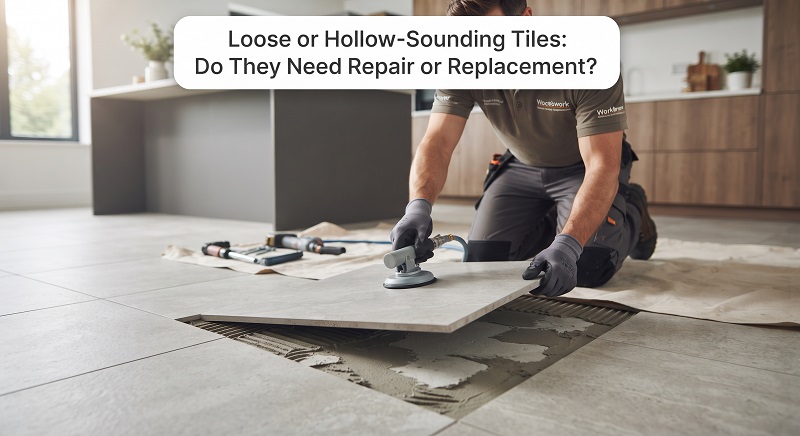
You step onto a kitchen tile and hear a hollow knock. The tile looks intact, but you wonder whether it needs replacing—and whether the rest of the floor will have to come up.
Loose or hollow-sounding tiles do not all need the same treatment. A hollow sound without movement or damage may only need assessment and monitoring. A tile that rocks, lifts or shifts needs attention. Whether it can be reset or must be replaced depends on the tile’s condition and what has failed underneath.
A Hollow Sound Is Not the Same as a Loose Tile
A hollow-sounding tile produces a different note when lightly tapped. That sound can come from a void in the adhesive, but membranes and the construction beneath the tiles can also affect acoustics. Sound alone cannot establish how much adhesive contact exists or whether the bond has failed.
A loose tile physically moves relative to the surface beneath it. You may notice a rocking edge, a clicking sound during normal use, or grout separating around it. This calls for investigation rather than simply covering the joint with fresh grout.
In Australia, hollow-sounding tiles are often called drummy tiles. The useful question is whether the tile remains securely supported, not just what noise it makes.
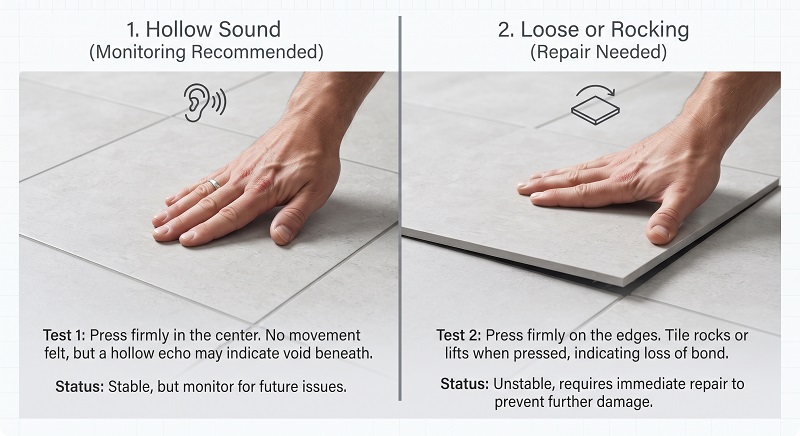
Loose or Hollow-Sounding Tiles: Which Signs Need Attention?
Use these observations to decide your next step. They guide an assessment; they do not confirm the cause.
| What you notice | What it may indicate | What to do next |
|---|---|---|
| A hollow note, with no movement or visible damage | A difference in the tile assembly or a local void | Record the location; ask the installer or a tiler whether assessment or monitoring is appropriate |
| A tile rocks or clicks during normal use | Loss of bond or support | Limit traffic and arrange an inspection |
| Cracked or missing grout around the same tile | Movement in the tile or underlying surface | Investigate before regrouting |
| Several tiles lift into a ridge | Stress or movement within the installation | Keep people off the affected area and seek prompt assessment |
| Loose tiles alongside damp patches or nearby swelling | A possible moisture-related problem | Investigate the moisture source and the tile installation |
| A wall tile moves or bulges | Potential loss of adhesion | Keep clear; do not pull it off or press it back into place |
What Causes Tiles to Sound Hollow or Come Loose?
Possible causes include:
- Incomplete adhesive contact. Gaps can leave parts of a tile unsupported. Applying isolated blobs of adhesive can create substantial voids in installations that require a continuous adhesive bed.
- A weak bonding surface. Dust, unsuitable coatings or poorly prepared material beneath the adhesive can interfere with adhesion.
- Movement beneath or around the tiles. A flexing floor or movement that the installation cannot accommodate can stress the bond. Replacing a tile without dealing with that movement leaves the new work exposed to the same problem.
- An unsuitable adhesive system. For example, some premixed adhesives struggle to dry between dense tiles and waterproofing membranes. The adhesive can remain soft, allowing movement or debonding.
- The construction of the tiled surface. Some membranes and framed floors or walls change the sound even when the tiles remain bonded.
The tile material alone does not explain the fault. Buying a stronger replacement tile will not correct a weak substrate or an unsuitable adhesive.
What Can You Check Before Calling a Tiler?
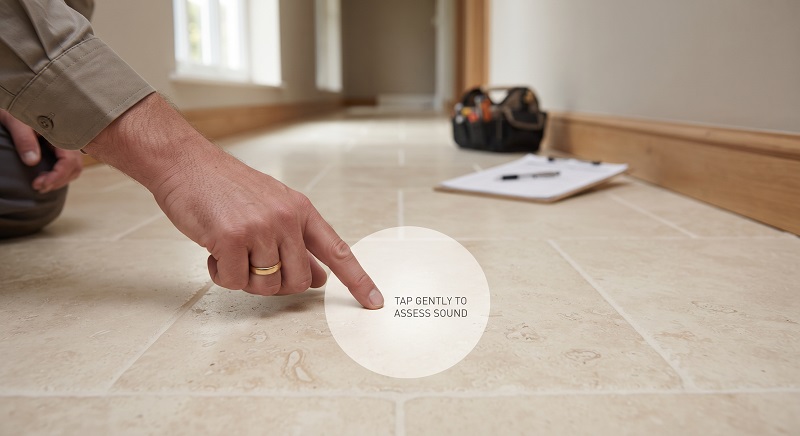
Start with a visual check. Photograph the affected tile and its surrounding joints, then take a wider picture showing where it sits in the room. Note when you first noticed the problem and whether it is changing. If the surface is intact, you can lightly tap with a knuckle and compare neighbouring tiles. Treat any difference as information to pass on, not proof that the tiles have detached. Do not hit them with metal tools, jump on them or try to force movement.
For recently completed work, contact the original installer before drilling, injecting adhesive or removing anything. If you rent, report the issue to your property manager rather than altering the installation.
When Is a Local Tile Repair Worth Considering?
A local repair is most practical when the problem is limited, the surrounding installation is sound and the cause can be addressed within that area.
Before accepting a repair quote, ask:
- Is the tile itself reusable? An intact tile may sometimes be removed, cleaned and reset, but it can break during removal.
- Is the surface beneath it sound? Any weak or damaged material needs attention before the tile goes back.
- Are nearby tiles affected? The visible loose tile may be only part of the problem.
- Is a compatible spare available? Keep spare tiles and any box labels for colour, size and batch checks.
- Could removal disturb waterproofing? Wet-area work needs a plan for protecting or restoring the waterproofing system.
A repair should restore support and adhesion. Regrouting alone does not rebond a loose tile.
Repair or Replacement: Compare the Options
“Replacement” may mean one tile, a small section or a larger area. A single loose tile does not automatically justify removing the entire floor.
| Option | When it may suit | Main limitation |
|---|---|---|
| Assessment and monitoring | A stable tile with an unusual sound and no other symptoms | It does not establish concealed adhesive coverage |
| Removing and resetting the existing tile | An intact tile that can be recovered, with a repairable underlying surface | Removal and cleaning may damage the tile |
| Replacing individual tiles | Localised damage with compatible replacements available | New tiles or grout may differ in shade, size or finish |
| Specialist injection repair | An installation that meets the chosen product system’s requirements | It may leave the original cause unresolved and is not suitable for every substrate |
| Retiling a section or larger area | Widespread failure, recurring movement, or underlying work that requires access | More removal, preparation and disruption |
Ask the contractor to explain why the recommended scope is necessary. The quote should distinguish tile work from substrate repairs and any waterproofing work.
Can Adhesive Injection Fix Hollow Tiles Without Removal?
Injection places a repair material beneath existing tiles to fill accessible voids or restore a bond. It can preserve tiles, but suitability depends on the product, substrate, moisture conditions and cause of failure.
ARDEX’s technical bulletin for its described crack-resin method limits use to concrete and sound screeds. It does not recommend that method over timber, compressed fibre-cement sheets or waterproofing membranes, and says it does not resolve waterproofing leaks. Those restrictions apply to that particular method; other systems need their own documented suitability checks.[3]
Before choosing injection, ask for the product name, evidence that it suits your installation, and an explanation of what happens if the tiles remain unstable. A hollow sound alone is not a reason to start drilling.
Bathroom and Outdoor Tiles Need Additional Checks
In a bathroom: loose tiles near a shower, damp adjoining walls or recurring moisture damage need more than a surface repair. A hollow sound does not prove a leak, and resetting tiles does not by itself repair failed waterproofing. Removal can also disturb the membrane, so agree on the wet-area repair scope before work begins. For relevant installation work, see our bathroom tiling services in Melbourne.
Outdoors: assess drainage, the underlying surface and provision for movement before relaying tiles. Our outdoor tiling tips explain the planning issues to discuss when an outdoor area needs reinstallation.
What Should You Avoid Doing?
Do not lay new tiles over an unstable tiled surface to hide the problem. The new finish depends on the layers below it. Our guide to tiling over existing tiles covers the option, but loose tiles and unresolved underlying defects need attention first.[5]
Also avoid filling movement joints with rigid grout or repair resin. These joints serve a different purpose from ordinary grout joints and need to retain their ability to accommodate movement.[6]
If removal is proposed, agree on protection, disposal and substrate preparation in the quote. Our tile floor removal guide outlines the stages, but removing tiles from a waterproofed area requires particular care.
What Affects the Repair or Replacement Cost?
The number of tiles is only one part of the price. Ask for the following items to be identified:
- Assessment and access: locating the affected area and working around fixtures or furniture.
- Removal and disposal: including protection of neighbouring tiles and finishes.
- Replacement materials: tile availability, matching and adhesive selection.
- Underlying repairs: preparation, damaged substrate or necessary waterproofing work.
- Finishing and return visits: grout, sealant and product-specific curing time.
A small repair can still involve several stages or visits. Compare the proposed scope rather than assuming the lowest price includes everything.
Conclusion
If the tile only sounds hollow and remains stable, do not replace it on sound alone. Record the area and get advice on whether monitoring or further assessment is appropriate. If it moves, lifts or shows associated damage, arrange an inspection. Localised problems may be resolved by resetting or replacing individual tiles. Broader retiling becomes more reasonable when failures are widespread or the underlying surface needs work that cannot be completed through a small repair.
For loose or hollow-sounding tiles in your Melbourne home, contact TileUnique with clear photos, your suburb, the approximate number of affected tiles and any spare-tile details. We can discuss the issue and whether an on-site assessment is needed before quoting the tiling work.