
Dust, footprints and dried spills can quickly make laminate flooring look dull, even when the floor is still in good condition. The problem is often not the amount of cleaning, but the method. Too much water can damage the joints, while unsuitable cleaners may leave streaks, sticky residue or a cloudy finish.
Knowing how to clean laminate flooring properly helps you remove everyday dirt without damaging its protective surface. In most homes, a soft microfibre mop, a suitable floor cleaner and a small amount of moisture are all you need. This guide covers the best cleaning methods, how often to clean laminate floors, which household products to avoid, and how to remove stubborn stains without causing unnecessary damage.
What Is the Best Way to Clean Laminate Flooring?
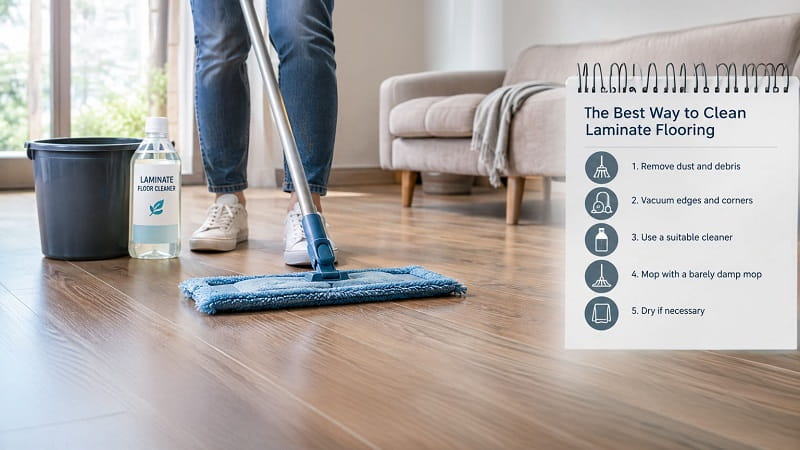
The best way to clean laminate flooring is to remove loose dirt first, mop with a barely damp microfibre mop, and dry any remaining moisture promptly. Unlike some other flooring materials, laminate should not be treated as a surface that can tolerate regular soaking.
Laminate flooring typically consists of a decorative layer protected by a durable wear layer, supported by a core that may contain wood fibres. The surface can resist everyday wear, but moisture entering unprotected joints may cause swelling, raised edges or separation between boards.
For everyday cleaning, follow this simple routine:
- Remove dust and debris. Sweep the floor with a soft-bristled broom or use a microfibre dust mop.
- Vacuum corners and edges. Use a hard-floor attachment and avoid a rotating brush that could scratch the surface.
- Prepare the cleaning solution. Use a laminate-safe cleaner according to its label and the flooring manufacturer’s instructions.
- Mop lightly. Wring out the microfibre mop until it is barely damp. Never leave puddles or wet trails behind.
- Work in manageable sections. Clean along the length of the boards and rinse or change the mop pad when it becomes dirty.
- Dry the floor if necessary. Use a clean, dry cloth to remove any visible moisture, especially around joints and edges.
There is no need to use large quantities of cleaner or repeatedly mop the same area. If a section remains dirty, identify the residue or stain and treat it separately rather than soaking the entire floor.
How Often Should You Clean Laminate Flooring?
The ideal cleaning schedule depends on how many people use the room, whether you have pets, and how much dirt enters from outside. A busy entrance or kitchen will generally need more attention than a spare bedroom.
| Cleaning task | Suggested frequency | Why it matters |
|---|---|---|
| Sweep or dry-mop | Daily or every few days | Removes grit, dust and hair before they accumulate |
| Wipe up spills | Immediately | Prevents liquid from entering joints or leaving stains |
| Vacuum edges and corners | Weekly, or as needed | Removes dirt that a mop may miss |
| Damp-mop the floor | About once a week, adjusting to use | Removes marks and surface grime |
| Check beneath mats and furniture | Periodically | Helps identify trapped moisture and accumulated dirt |
These are starting points rather than strict rules. A household with pets, children or frequent visitors may need to remove loose dirt every day, while a lightly used room may require less frequent mopping.
One important distinction: frequent dry cleaning is generally more useful than frequent wet cleaning. If the floor looks clean after sweeping or vacuuming, there is no need to mop it simply because another day has passed.
What Cleaning Products Are Safe for Laminate Floors?
If your home has different flooring materials, remember that each surface may require a different cleaning method. For example, the products and techniques used for laminate flooring may not be suitable for ceramic or porcelain tiles. Read our guide on how to clean bathroom tiles to learn how to maintain tiled surfaces without damaging their finish.
Laminate floor cleaner
A dedicated laminate cleaner is usually the most straightforward choice. Follow the dilution instructions carefully if the product needs to be mixed with water. Using more than recommended can leave residue rather than improve the result.
Where possible, choose a cleaner that does not require rinsing and is designed not to leave a film, provided it is compatible with your flooring.
Warm water
Warm water can help loosen light dirt, but it should be used sparingly. If the flooring manufacturer permits water-based cleaning, apply it through a well-wrung mop or a cloth rather than pouring water directly onto the floor.
Avoid hot water and excessive moisture. The aim is to remove surface dirt without allowing water to collect between the boards.
Can you use vinegar to clean laminate flooring?
Vinegar is often recommended in homemade floor-cleaning recipes, but it should not be treated as a universally safe solution. Its acidity may affect the finish of some products, and certain manufacturers prohibit acidic cleaners.
Before using vinegar, check the care instructions and warranty for your specific floor. If the manufacturer recommends a dedicated laminate cleaner, use that instead. There is little benefit in experimenting with a homemade mixture when a compatible product is available.
Is washing-up liquid safe for laminate floors?
A small amount of washing-up liquid may appear to remove greasy marks, but ordinary dish soap can leave a film if it is not suitable for the surface or is used in excess. This residue can attract dirt and make the floor look dull.
For routine cleaning, use a compatible laminate cleaner rather than experimenting with household detergents. If you are dealing with a greasy spill, clean the affected area with a product approved for laminate and wipe away the residue as directed.
How to Clean Laminate Flooring Without Streaks
Streaks usually develop when cleaning solution dries unevenly, too much product is used, or dirt and detergent residue remain on the surface. Using more water to remove the marks can make the situation worse.
To achieve a cleaner, more even finish:
- Remove dust first. Fine particles can spread across the floor during mopping and leave visible marks.
- Use the correct amount of cleaner. Follow the product label instead of adding extra solution in the hope of getting a better result.
- Keep the mop clean. A dirty pad redistributes grime instead of removing it.
- Avoid excessive moisture. A barely damp mop gives you more control and reduces drying time.
- Work in sections. Clean a manageable area at a time so that the solution does not dry unevenly.
- Check the floor in natural light. Window light can reveal streaks that are difficult to see under artificial lighting.
If streaks remain after cleaning, consider whether the floor has a build-up of old polish, detergent or another product. Repeatedly applying different cleaners may add to the problem. Check the manufacturer’s recommended procedure for removing residue before trying a stronger solution.
Do not use wax or furniture polish to make laminate look shinier. Laminate has its own finished surface, and products designed to polish timber can leave a slippery or cloudy layer.
How to Remove Stubborn Stains from Laminate Flooring
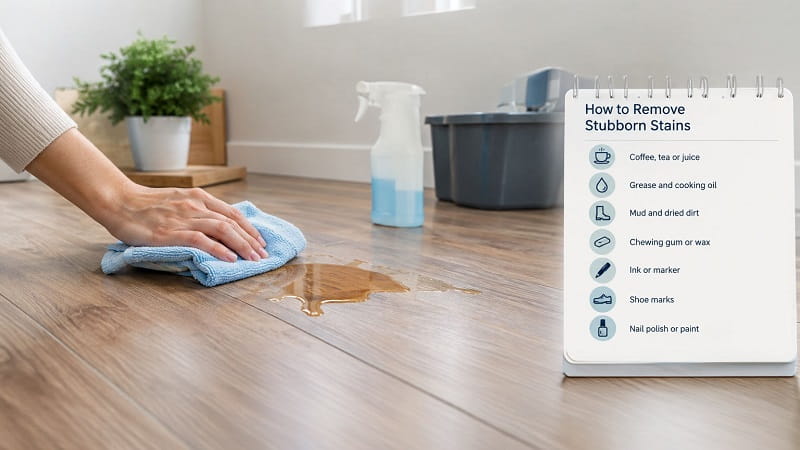
Everyday dust is relatively easy to remove, but dried food, grease, ink and chewing gum need a more targeted approach. The key is to treat the stain without scratching the wear layer or allowing cleaning liquid to enter the joints.
| Type of stain | Recommended approach | What to avoid |
|---|---|---|
| Coffee, tea or juice | Blot the spill with a soft cloth, then wipe with a slightly damp cloth and a compatible cleaner | Leaving the liquid to dry or spreading it across a large area |
| Grease and cooking oil | Absorb the excess with paper towel, then clean the remaining film with a laminate-safe product | Abrasive powders and aggressive degreasers |
| Mud and dried dirt | Allow the dirt to dry, remove loose material gently, then wipe away remaining marks | Scrubbing grit across the surface |
| Chewing gum or candle wax | Let it harden and carefully lift it with a blunt plastic scraper if permitted by the manufacturer | Metal blades, sharp tools and excessive force |
| Ink or permanent marker | Test a manufacturer-approved spot cleaner on an inconspicuous area first | Applying solvents directly to the floor or allowing them to reach the joints |
| Shoe marks | Try a clean microfibre cloth and an approved cleaner | Scouring pads and abrasive cleaning products |
| Nail polish or paint | Follow the flooring manufacturer’s stain-removal instructions before using any solvent | Acetone, paint thinner or nail-polish remover without checking compatibility |
How to deal with dried food and sticky spills
Start by removing any loose material without scraping the floor. Place a soft cloth dampened with a suitable cleaner over the affected spot for a short period, if the product instructions allow it. Wipe gently, then remove any remaining moisture.
Do not leave a wet cloth sitting on the floor for an extended period. If the mark does not come away easily, repeat the approved spot-cleaning process rather than increasing the pressure or using a rough pad.
What if a stain will not come off?
Some marks are not ordinary dirt. They may be residue from an unsuitable cleaning product, discolouration of the decorative layer, or damage to the finish.
If gentle cleaning does not work, check the flooring manufacturer’s guidance or ask a flooring professional to identify the cause. Stronger chemicals may remove a mark, but they can also permanently alter the surface.
How to Clean Laminate Floors in the Kitchen
Kitchen laminate floors often collect grease, food crumbs and sticky marks around the sink, cooker and dining area. These areas benefit from frequent dry cleaning and immediate attention to spills.
Start by sweeping or vacuuming the floor, paying particular attention to the edges of cabinets and beneath movable furniture. Remove crumbs and other debris before using a damp cloth or mop.
For greasy areas, use a cleaner approved for your flooring and apply it sparingly. Clean small sections rather than wetting the entire kitchen floor at once. Wipe up spills around the sink and dishwasher as soon as possible, especially if water could run beneath the boards.
Pay attention to these common problem areas:
- Around the sink: Wipe up splashes rather than allowing water to collect along the edges.
- Near the dishwasher: Check for leaks and clean any water that escapes during a cycle.
- Under the dining table: Remove crumbs and food residue before they become sticky.
- At the entrance: Use a suitable mat to catch dirt and moisture brought in on shoes.
If your kitchen has laminate flooring labelled water-resistant or waterproof, follow the product-specific instructions. These terms do not necessarily mean that every joint, edge or installation detail can withstand standing water indefinitely.
How to Clean Laminate Flooring with Pets in the House
Pet hair, muddy paw prints and occasional accidents can make laminate flooring harder to maintain. Fortunately, most of these problems can be managed without specialist equipment.
A microfibre dust mop or a vacuum suitable for hard floors will help remove loose hair before it accumulates around skirting boards and furniture legs. For muddy paw prints, allow heavy mud to dry where practical, remove the loose dirt, and then wipe the marks with a slightly damp cloth.
For urine or other pet accidents, absorb the liquid immediately using paper towel or a clean cloth. Use a pet-safe product that is also approved for laminate flooring, following the label instructions. A product being safe for pets does not automatically make it suitable for laminate surfaces.
Avoid masking unpleasant smells with fragrance sprays or pouring disinfectant onto the floor. If an odour persists, liquid may have entered the joints or travelled beneath the flooring. In that case, surface cleaning alone may not resolve the problem.
Can You Use a Steam Mop on Laminate Flooring?
In most cases, you should avoid using a steam mop on laminate flooring unless the manufacturer explicitly approves that method for your exact product.
Steam mops combine heat and moisture. Vapour can penetrate joints or vulnerable edges, potentially damaging the core or affecting the floor’s finish. Problems may appear as swelling, raised edges, separation or changes in surface texture.
Even if a laminate product is advertised as water-resistant, do not assume it is suitable for steam cleaning. Water resistance varies by product, and the manufacturer’s maintenance instructions and warranty conditions should determine which cleaning methods are permitted.
A microfibre mop with minimal moisture is a better default choice. It removes everyday grime without exposing the floor to the same combination of heat and steam.
How to Remove Bad Smells from Laminate Flooring
An unpleasant smell after cleaning may indicate that dirty water, detergent residue or a spill has been left on the surface. In other cases, liquid may have entered the joints or accumulated underneath the floor.
Start with the simplest checks:
- Remove rugs and mats, then inspect the floor beneath them.
- Wipe the surface using a clean cloth and a suitable laminate cleaner.
- Dry the area thoroughly and improve ventilation.
- Check for leaks around appliances, sinks and nearby plumbing.
- If the smell persists, look for signs of swelling, discolouration or moisture around the edges.
Do not flood the floor with disinfectant or fragrance-based cleaners. If moisture has penetrated beneath the boards, adding more liquid may worsen the issue. Persistent odours accompanied by dampness or raised boards may require a flooring professional to inspect the installation.
What Causes Laminate Flooring to Swell or Lift?
Swelling and lifting are not simply signs that the floor needs a deeper clean. They often indicate a moisture problem, although installation defects and insufficient expansion space can also contribute.
Common causes include:
- Water left standing on the floor or repeatedly entering the joints.
- Leaks from dishwashers, washing machines, sinks or plumbing.
- Moisture trapped beneath the flooring.
- Inadequate expansion gaps around the room’s perimeter.
- Installation problems that cause boards to press against walls or fixed objects.
Moisture-related problems are not always caused by cleaning habits. Poor preparation, unsuitable materials and installation errors can also lead to costly flooring and renovation issues. If you are planning a home renovation, our guide to common tiling mistakes and how to avoid them explains some of the problems worth addressing before installation begins.
If you are planning to replace damaged tiles or update the tiled areas of your home, explore our professional floor tiling services to learn more about the available options for your renovation.
Common Mistakes to Avoid When Cleaning Laminate Flooring
Many cleaning problems arise from trying to make the floor exceptionally clean in a single session. Laminate usually needs gentle, consistent care rather than aggressive treatment.
| Mistake | Why it causes problems | Better approach |
|---|---|---|
| Using a soaking wet mop | Water can penetrate the joints and damage the core | Use a well-wrung, barely damp mop |
| Pouring cleaner directly onto the floor | Liquid may collect in seams and edges | Apply the cleaner as directed, usually to the cloth or mop |
| Using abrasive pads | They may scratch the protective finish | Use soft microfibre cloths |
| Applying wax or polish | It can leave residue and make the surface slippery | Maintain the original finish with a suitable cleaner |
| Using a steam mop without approval | Heat and moisture may damage the floor | Check the product’s care instructions |
| Ignoring spills | Liquids can stain the surface or penetrate joints | Blot spills promptly |
| Using too much cleaning solution | Excess product can leave a dull or sticky film | Follow the recommended dosage |
| Dragging furniture across the floor | Furniture legs can scratch or mark the surface | Use protective felt pads and lift furniture when possible |
How to Keep Laminate Flooring Clean for Longer
- Good maintenance reduces the amount of cleaning required and helps prevent avoidable wear. A few small habits can make a noticeable difference over time.
- Use entrance mats. Place suitable mats near external doors to catch grit, mud and moisture before they reach the floor. Check that the mat’s backing is compatible with laminate and does not trap moisture underneath.
- Fit protective pads to furniture. Chairs, tables and other movable items can scratch the surface when pushed across it. Use clean felt pads and replace them when they become worn or collect grit.
- Clean spills straight away. Do not wait until the next scheduled cleaning session. Blot liquid promptly and dry the affected area.
- Avoid dragging heavy items. Lift furniture where possible, or use appropriate moving aids that will not damage the surface.
- Keep the floor free of abrasive debris. Sand and small stones can cause fine scratches when repeatedly walked across. Regular dry cleaning is particularly helpful in entrances and hallways.
- Follow the manufacturer’s care instructions. Keep the product’s maintenance guidance available so that you can check which cleaners and equipment are suitable.
- These steps will not prevent every type of wear, but they help preserve the appearance of the floor without relying on unnecessary chemicals or intensive cleaning.
Conclusion
The most reliable way to clean laminate flooring is to sweep or vacuum regularly, use a barely damp microfibre mop with a compatible cleaner, and remove moisture promptly. This routine is usually enough to deal with everyday dust, footprints and surface grime without putting unnecessary stress on the floor.
For stubborn stains, use a targeted product approved for your flooring rather than resorting to abrasive tools, strong chemicals or excessive scrubbing. Avoid steam cleaning unless the manufacturer specifically permits it, and never assume that a water-resistant product can withstand standing water.
If the boards are swelling, lifting or developing persistent odours, investigate possible moisture or installation problems instead of treating the issue as a cleaning problem.
With the right cleaning routine and a few simple preventive measures, you can maintain the appearance of laminate flooring while reducing the risk of avoidable damage.