
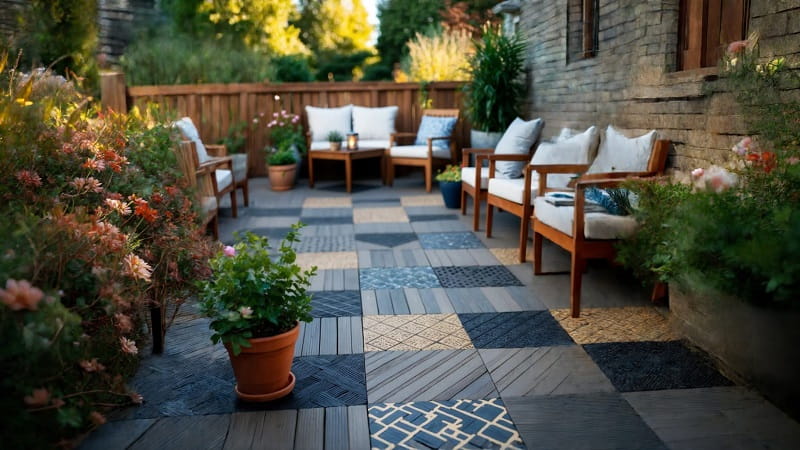
If your garden only needs somewhere to put a table and two chairs, tiling the entire space could spend most of your budget on flooring you rarely use. A compact seating area, a short garden path or a refresh of sound existing tiles may solve the problem for less.
The most useful small garden tile ideas on a budget start with how you use the space. Decide where you need a firm surface, check what is already underneath it, then compare materials and installation costs. A cheaper tile will not necessarily produce a cheaper project if it needs extensive groundwork or complicated cutting. Here are seven practical options, followed by advice on materials, quantities and the parts of installation worth paying for.
Small Garden Tile Ideas on a Budget: 7 Practical Options
1. Tile a Compact Seating Area Instead of the Whole Garden
Start with the furniture you intend to use. Mark its position on the ground, pull the chairs out and check that you can walk around them comfortably. Use that footprint to plan the tiled area.
A square or rectangular seating zone is a useful starting point because it can simplify the perimeter and tile layout. Keeping planted borders around it also leaves room for greenery without paying to tile every corner.
This approach suits a garden where the main priority is morning coffee, outdoor meals or a small bench. If your existing paving already covers those activities, extending it may offer little practical benefit.
2. Combine Outdoor Pavers with Gravel
Use a continuous paved surface beneath furniture and gravel around planting or along less-used edges. This can reduce the area requiring paving, although excavation, edging and base preparation still belong in the budget.
Choose the arrangement around daily use:
- Keep chair legs and table legs on the paved section.
- Use edging to stop loose gravel migrating onto the seating area.
- Provide a firm, continuous route where wheelchairs, walking aids or pushchairs need access.
- Keep gravel clear of door tracks and drainage outlets.
Gravel does not automatically fix drainage. Water still needs somewhere to go, and the ground beneath it must suit the proposed construction.
3. Create a Stepping-Stone Path with Suitable Outdoor Pavers
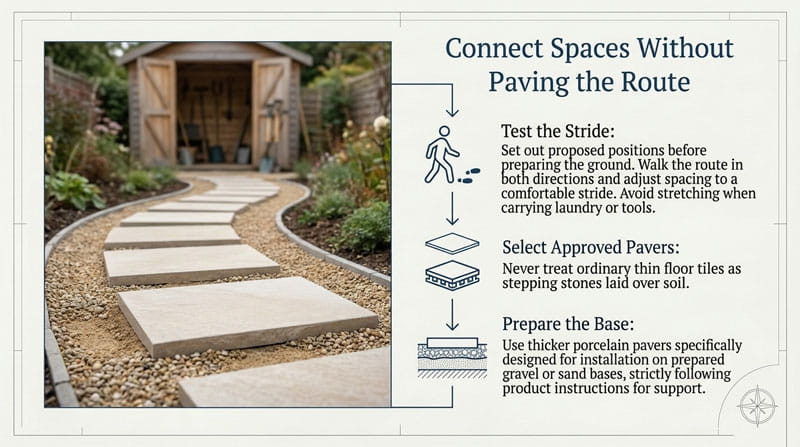
A stepping-stone path can connect the back door to a shed, washing line or seating area without paving the whole route. Set out the proposed positions before preparing the ground. Walk the route in both directions and adjust the spacing to a comfortable stride. Avoid placing stones so far apart that you need to stretch, especially where you might carry laundry or gardening tools.
Use a product approved for the installation method. Ordinary thin floor tiles should not be treated as stepping stones laid over soil. Some thicker porcelain pavers are designed for installation on prepared gravel or sand bases, but the product instructions determine the required support. For a frequently used access route, a continuous path may be more practical than separated stones.
4. Use Stone-Look Porcelain in One Small Feature Area
If you like the appearance of stone, compare exterior-rated stone-look porcelain with natural stone options. Request prices for the complete installed area rather than assuming one material will always be cheaper.
A small porcelain terrace outside the back door can provide the finish you want while leaving the rest of the garden planted. Choose an outdoor floor product with documented suitability for the exposure and expected use.
Before ordering, take a sample outside. Look at it beside your brickwork, fence and furniture in both sunlight and shade. A colour that looks warm in a showroom may look noticeably different in your garden.
5. Keep the Main Tiles Plain and Add a Patterned Accent
A patterned border or small inset can add detail without requiring decorative tiles across the entire surface. The saving depends on the product price and the extra labour needed to form the design.
| Accent idea | Where it may work | What to check before choosing it |
|---|---|---|
| A contrasting border | Around a simple rectangular seating area | Whether it creates narrow cuts at the edges |
| A small patterned inset | Beneath a table or outside a doorway | Matching thickness, suitability and joint layout |
| A change in tile direction | Between a path and seating area | Cutting requirements and alignment |
| A contrasting edge strip | Along a planted boundary | Edge support and compatibility with the main tile |
Ask the installer to price both the plain layout and the accent version. A decorative detail is worthwhile when its visual benefit justifies the additional work.
6. Buy Clearance Tiles Only After Checking the Full Quantity
End-of-line stock can suit a small project because fewer boxes may be needed. However, a discount becomes less useful if you run short and cannot find matching replacements.
Before paying, confirm:
- The tiles are suitable for an exterior floor.
- The available quantity covers the layout, cutting allowance and spare tiles.
- Boxes have compatible batch and size markings where applicable.
- The tiles are free from damage that affects their use.
- Delivery charges and return conditions are clear.
Keep spare pieces for future repairs. An unavailable replacement can make a single damaged tile much harder to deal with later.
7. Refresh Sound Existing Tiles Before Replacing Them
If the current surface is stable and drains properly, cleaning may be the lowest-cost improvement. Test a cleaner approved for the tile or paving material on a small area before treating the whole space. Persistent staining needs a different approach from loose tiles, recurring cracks or standing water. Cleaning can improve appearance; it cannot correct an installation defect.
If tiles move or cracks keep returning, investigate the cause before spending money on cosmetic work. Our guide to loose or hollow-sounding tiles explains why the repair decision depends on more than appearance.
Which Tiles and Pavers Suit a Small Garden on a Budget?
The important distinction is between the surface material and the system supporting it. A tile intended to be bonded to concrete is not interchangeable with a paver approved for a prepared granular base.
Use this comparison to narrow your shortlist:
| Material | Potential budget advantage | Costs or limitations to investigate |
|---|---|---|
| Exterior-rated porcelain tiles | May suit an existing concrete slab that needs limited preparation | Slab repairs, adhesive, grout, cutting and movement joints |
| Porcelain pavers approved for the proposed base | May offer installation options beyond a bonded tile system | Excavation, base construction, edge restraint and product-specific requirements |
| Concrete pavers | Worth comparing for paths and straightforward seating areas | Delivered price, base preparation and care requirements for the selected finish |
| Natural stone paving | Can be used selectively where its appearance matters most | Installation, cleaning and any sealing required for that stone |
Do not choose by the word “porcelain” alone. Ask for the specific product’s outdoor suitability, slip-test information and installation instructions.
A matt appearance is not proof of adequate slip resistance. Match the product to the actual conditions, including rain exposure, garden irrigation and whether people will use it barefoot.
How Much Should You Budget for a Small Garden Tiling Project?
Calculate the area first, then separate the tile order from the installation budget. For example, a rectangular seating area measuring 3 metres by 2.4 metres covers 7.2 m². If a preliminary estimate uses a 10% cutting allowance, the material quantity becomes 7.92 m², before rounding up to full boxes. That allowance is an example, not a fixed rule. The final quantity should follow the tile dimensions, layout and number of cuts.
Ask for a quote that identifies:
- Removal of existing finishes and disposal.
- Excavation or repairs to the supporting surface.
- Base construction and drainage work.
- Tiles or pavers, including delivery.
- Adhesive, grout, jointing materials and edge details.
- Installation labour and any equipment hire.
- Sealing or specialist treatments where required.
- GST, exclusions and the handling of unexpected work.
Compare quotes for the same scope. A lower figure that excludes substrate repairs cannot be compared directly with one that includes them. If the total is too high, reduce the paved footprint or simplify the design before changing to a product unsuitable for the site.
What Tile Size, Colour and Layout Work Best in a Small Garden?
A restrained palette can help a compact garden feel less visually crowded. Start with one main surface colour that works with the house and planting, then decide whether an accent is necessary.
For size and layout, use these checks:
- Fit matters more than size alone. Compare tile dimensions against the actual width and length of the proposed area.
- Inspect the perimeter cuts. A layout with thin strips around the edges may need adjusting.
- Price a straight layout first. Compare decorative alternatives against that baseline.
- Consider cleaning when choosing texture. Examine how soil and leaf debris might collect in the selected finish.
- View grout samples beside the tile. A similar shade can make the joints less prominent, although cleaning is still necessary.
Do not assume large tiles automatically save money. Fewer pieces can still require more demanding handling, preparation or cutting.
Can You Reuse the Existing Patio or Tile Over It?
Sometimes, but the existing surface needs assessment before it becomes part of the new installation.
A sound concrete slab may provide a useful starting point. Cracking, contamination, poor drainage or unstable sections can change the work required. Existing tiled surfaces need their own checks because the new finish depends on the layers underneath.
Adding tiles also raises the finished floor level. Near a doorway, that may affect the threshold, drainage arrangements or the transition between inside and outside.
Our guide to tiling over existing tiles introduces the option. For an outdoor project, have the installer confirm that the existing surface and proposed product system are suitable before treating avoided demolition as a saving.
Where Can You Save Money, and What Should You Never Skip?
The best savings usually come from reducing unnecessary work. Removing essential preparation can leave you paying for the same area twice.
| Sensible ways to reduce the budget | Work that needs proper provision |
|---|---|
| Tile only the area you will regularly use | Stable support beneath the chosen surface |
| Choose a simple outline and layout | Drainage and appropriate finished levels |
| Compare suitable clearance products | Verified suitability for exterior foot traffic |
| Retain existing surfaces after assessment | Required movement joints and edge details |
| Complete the project in planned stages | Compatible installation materials |
| Move furniture and pots before work starts | Investigation of existing defects |
For a staged project, decide the eventual layout now. Otherwise, a later extension may require removing finished edges or trying to match discontinued tiles.
Our outdoor tiling tips cover further planning questions to discuss with your installer.
DIY or Professional Installation: Which Jobs Can You Take On?
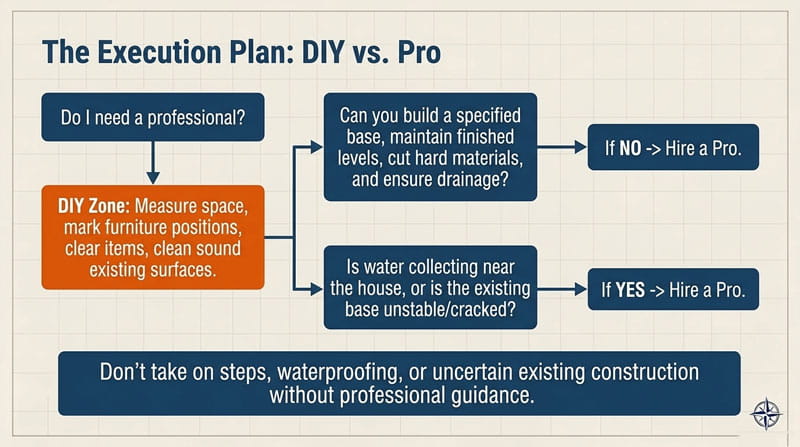
You can contribute to a project without taking on every part of the installation. Measuring the space, marking furniture positions, comparing samples and clearing movable items are useful starting tasks. Cleaning a sound existing surface may also be manageable when you follow the material supplier’s care instructions.
Before committing to installation yourself, check whether you can:
- Build the specified base and maintain the required finished levels.
- Provide the drainage arrangement the site needs.
- Handle and cut the selected product with suitable equipment.
- Follow the adhesive or paving system’s instructions.
- Complete edges, joints and transitions correctly.
Get professional advice where water collects near the house, the base is unstable, or the work involves steps, waterproofing or uncertain existing construction. For help comparing layouts and defining the installation scope, discuss the project through our tile design and installation service. Bring measurements and photographs, including close-ups of the existing surface and door thresholds.
Frequently Asked Questions
- Can garden tiles be laid directly on soil?
- Ordinary floor tiles should not be laid loose on soil. They need a suitable supporting installation system. Some outdoor pavers can be installed on prepared granular bases, but that is different from placing them on unprepared ground.
- Are larger tiles always cheaper for a small garden?
- No. The overall cost depends on purchase price, handling, preparation and cutting. A size that fits the area efficiently may offer better value than the largest available tile.
- Can leftover indoor tiles be used outdoors?
- Only if the manufacturer confirms suitability for the intended exterior floor application. Check exposure, slip resistance and installation requirements. Having enough leftover tiles does not establish that they are suitable.
- Are clearance tiles a good choice for garden projects?
- They can be, provided their specifications suit the project and enough matching stock is available. Confirm the full quantity and delivery cost before buying.
Conclusion
For a small garden that needs somewhere to sit, start with a compact, continuous seating area and a straightforward layout. Compare exterior-rated porcelain over a suitable existing slab with paver systems appropriate to the site. Choose using the complete installed price. If access is your main problem, prioritise a practical path. If the existing surface is sound, investigate cleaning and local repairs before replacement.
The most effective small garden tile ideas on a budget put a durable surface where it earns its cost. Measure that area, check the base and drainage, then choose the finish you can afford within a properly scoped installation.